|
Palm Beach Harbor Pilots
200 E. 13th St. Suite B
Riviera Beach, FL 33404
Voice: 1-561-845-2628
Office@palmbeachpilots.com
| |
LARGE VESSEL RESTRICTIONS
Click here for
NOAA Current and Tide Predictions for the Port of Palm Beach.
Due to the narrow width of the Inner Channel, all vessels with a beam of over 102' are restricted from entering.
The Inner Channel is also restricted to one-way traffic for vessels over 200' LOA.
Single screw cargo vessels under 106' beam may be considered with drafts under 24.
The 102' beam restriction may be adjusted to allow cruise ships into the port due to their lighter drafts and advanced maneuvering characteristics.
The maximum salt-water draft is 33'-00" for the Port of Palm Beach
when the channel and turning basin are free from shoaling. The
maximum salt water daft is 32'-00" for hydrocarbon tank vessels.
During periods when shoaling is present, further restrictions
beyond what is stated below might be applied to the length, draft,
and beam.
Vessels 600' LOA or greater, or a beam of 90' or greater, or a draft of 30' or greater, will enter only during daylight hours.
Vessels within 3 feet of maximum allowable draft are restricted to high water slack.
Vessels over 550' LOA or greater may be restricted to maneuvering during daylight slack water depending upon the draft of the vessel and the current weather conditions.
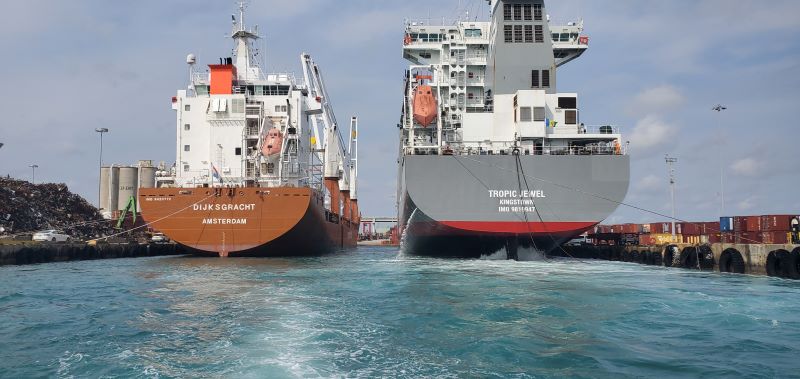
Our experience and with discussions with the local tug operators have shown that the when the combined beams of two adjacent vessels exceed 160' in the south slip, and 150' in the center
slip, there is limited room for the tugs to operate safely and effectively. Therefore, we must limit the combined beams within the slips to reflect the above maximums.
All vessels may expect delays when this situation occurs.
Agents of vessels using the South Slip with a draft of 31' or more should contact the Port for the latest soundings of that slip prior to arrival.
Vessels less than 550' LOA and 85' beam with 50' of clearance
in the slip can be safely handled using the local tugs under most
weather conditions. When vessels exceed this size or when the
weather deteriorates, we have found that it may be necessary to
restrict the draft in order to improve the maneuvering of the
vessel. The reasons for this are due to the strength of the Gulf
Stream at the mouth of the inlet and the width of the turn in
the inner channel.
Single screw vessels over 550' LOA may require a third local tug in adverse weather conditions.
Twin-screw ships, and single screw vessels fitted with thrusters, may not have all of the restrictions that are listed above depending upon the handling characteristics of the vessel.
The Pilots should be contacted regarding such vessels.
Additional recommendations for Oil Tankers and Barges
It is recommended that all inbound tank vessels carrying oil products transit during slack water for safety reasons. Flood tides should be avoided at all times. The maximum draft for oil is
32' unless limited by the above parameters or shoaling. Daylight is recommended for inbound drafts over 30'. Oil tank vessels under 25' draft may sail on any tide when pushing
ahead, weather permitting. Barges over 90' beam should not be towed until the Inner Channel turn is widened.
Additional Information for Cruise Ships at Berth #2:
The Cruise Ship Berth is 700' long with Yokohama type fendering. Cargo vessels docked on the opposite side of the berth may limit the width of this slip from 250' to 170'.
Ebb and flood currents flow across the entrance of the Cruise
Slip making docking and undocking challenging for poor handling
vessels. Newer cruise ships with azipods, or twin screw / twin
rudder type designs and strong bow thrusters can maneuver through
these currents under normal conditions. Strong storms and heavy
ground swell can make the Channel Entrance to the Port impassable
at times for larger cruise vessels.
It has been and will continue to be the decision of the Port of Palm Beach on what vessels will have priority and to which berths they will be assigned. We will continue to work with the staff
at the Port of Palm Beach in order to fully utilize the Port. Please contact the Port and the Pilots for further information before considering vessels for charter within the
parameters specified above.
|
|
|